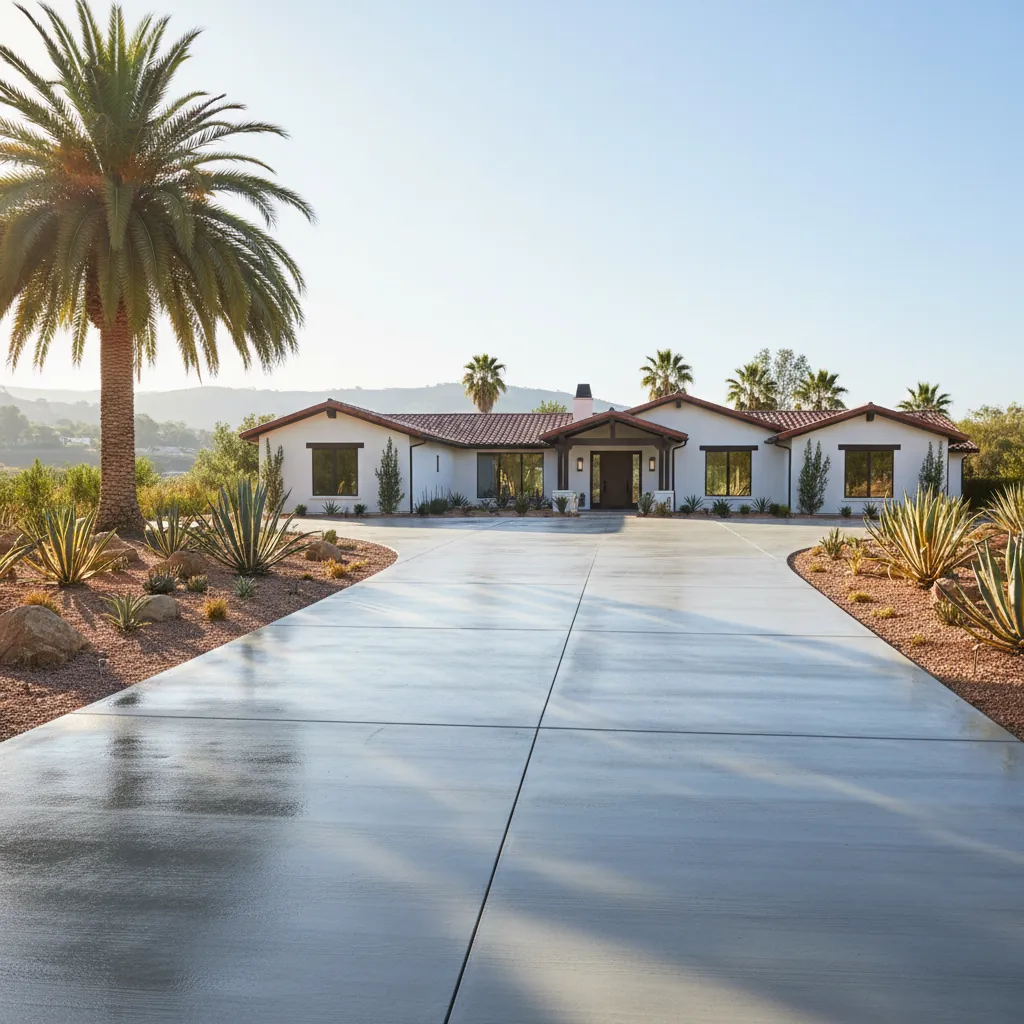
Local concrete pros in 63 Los Angeles-area neighborhoods. Each request goes to up to four of them.
Concrete contractors pour and replace driveways, walkways, patios, garage slabs, steps and small foundations, and they repair cracked or lifted flatwork. In Greater Los Angeles many calls involve breaking out 1950s and 1960s driveways heaved by tree roots or clay soil. In Greater San Antonio, new patios and driveway extensions are common, along with repairs where shifting clay has split older slabs. We share your project with nearby concrete companies so you can compare written bids side by side.
A replacement job usually means breaking out the old slab, hauling it away, grading and compacting the subgrade, adding a crushed rock base, setting forms, placing rebar or wire mesh and pouring. Finishers then float and trowel the surface, add a broom finish for grip or a decorative finish such as exposed aggregate or a stamped pattern, cut or tool control joints and cure the slab. Driveways are commonly four inches thick, more where heavy vehicles park. Most residential flatwork takes a day of demo and forms, a pour day, then several days before cars.
Soil is the main local variable. Expansive clay across much of the San Fernando Valley swells when wet and shrinks in summer, which cracks thin slabs laid without good base and rebar. Hillside lots need careful drainage and sometimes steps or retaining edges, and mature street trees lift drive aprons in older neighborhoods from Sherman Oaks to Pasadena. Near the coast, salt air argues for rebar with plenty of concrete cover. San Antonio mixes dark expansive clay in some areas with rocky caliche in others, and summer pours start early because heat speeds setting and can weaken the surface.
Private flatwork on your lot often needs no permit, but a new driveway approach or work in the city sidewalk usually does. In Los Angeles that typically involves city public works permits rather than only LADBS; separate cities like Burbank or San Marino run their own, and San Antonio requires right-of-way approval for curb cuts. Footings for patio covers or additions need building permits and an inspection before the pour. Avoid scheduling during rainy weeks. Concrete gains most of its strength in about 28 days, so hold off on heavy trucks for at least the first week.
| Job | Typical range | What moves the price |
|---|---|---|
| Driveway replacement | $10 - $18 / sq ft | Demo and haul-off of the old slab, thickness, rebar and access for the mixer truck or a pump. |
| New patio slab, broom finish | $8 - $14 / sq ft | Grading, base depth and whether a pump is needed to reach a backyard behind the house. |
| Stamped or colored concrete | $14 - $25 / sq ft | Pattern complexity, color layers and sealing; borders and steps raise the per foot cost. |
| Walkway or garden path | $9 - $16 / sq ft | Narrow runs need more form work per square foot, and curves add finishing labor. |
| Driveway approach or sidewalk section | $2,500 - $7,000 | Right-of-way permits, inspections and traffic control can rival the cost of the concrete itself. |
| Crack repair or slab lifting | $300 - $2,500 | Sealing hairline cracks is cheap; foam or mudjacking to raise sunken slabs depends on the area. |
Typical market ranges, not a quote. Your price depends on the house, the scope and the season; compare written quotes.
Type your ZIP code and we take you to the concrete page for your neighborhood. If we do not cover that ZIP yet, you go to the request form with it filled in.
We also match concrete requests in 5 San Antonio neighborhoods.
Driveway replacement in both metros often costs about $10 to $18 per square foot, demo and haul-off included. For a two-car driveway that frequently works out somewhere around $5,000 to $10,000, depending on size and slope. Decorative finishes, pump trucks and a new approach at the street add to the total.
Some cracking is normal as concrete shrinks while curing; control joints give those cracks a straight place to form. Wide or uneven cracks usually come from poor base compaction, soil movement or missing reinforcement. Expansive clay in the Valley and around San Antonio is a frequent cause when water collects along the slab edge.
Replacing a driveway on your own lot often needs no building permit, but cutting or replacing the curb approach and any sidewalk in the public right-of-way generally requires one. In LA that means a city public works permit; other cities and San Antonio have their own process. Ask the contractor to confirm before demolition.
Light foot traffic is generally okay within 24 to 48 hours. Most contractors suggest waiting about seven days before parking cars, and longer for heavy trucks or RVs. Hot weather in San Antonio or the Valley speeds early setting, which makes proper curing with water or a curing compound more important, not less.
Narrow cracks with no height difference can be sealed for a few hundred dollars. Sunken sections can sometimes be lifted with foam or mudjacking. When a slab is broken into many pieces, has a trip edge of more than about an inch, or roots are still pushing, replacement is usually the better spend.
Spring and fall give the most forgiving temperatures in both metros. Summer pours work if crews start early and protect the slab from fast drying. In Los Angeles, avoid days with heavy rain in the forecast. In San Antonio, watch for thunderstorms and the occasional hard freeze, which can damage fresh concrete.
