
Perched above the waters of Lake Travis, Lakeway homes feature expansive architectural layouts that often place laundry rooms far from exterior walls. These multi-story floor plans create unusually long, winding exhaust lines that easily trap lint and restrict airflow. We connect you with independent Lakeway dryer duct cleaning specialists who understand local home designs and keep your exhaust systems venting safely.
Measure initial airflow velocity and backpressure at the dryer connection point
Inspect the flexible transition hose behind the dryer for crimps, tears, and code compliance
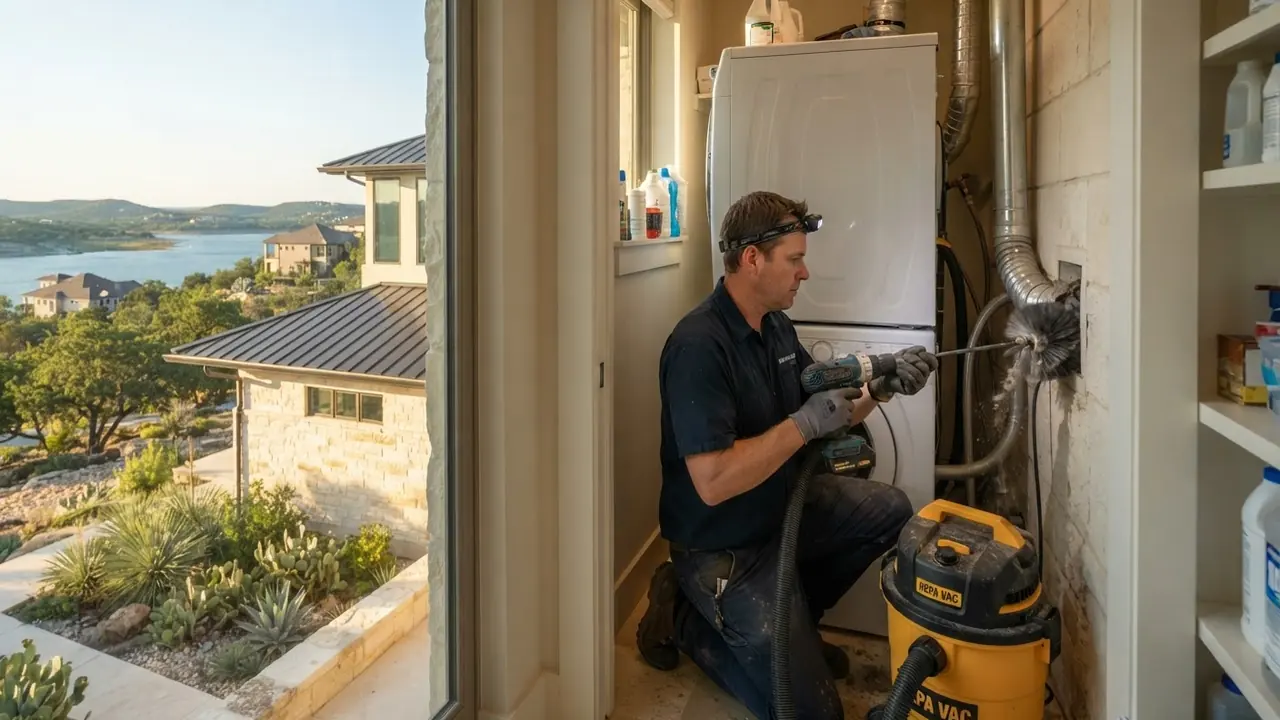
Insert professional rotary brush heads and high-CFM HEPA vacuum containment along the entire duct run
Access the exterior or roof terminal to remove lint buildup, test the damper flap, and clear the pest guard
Inspect in-line booster fans and secondary lint traps on extended multi-story runs
Typical for Lakeway single-level layouts where the dryer backs directly onto an exterior wall or short crawlspace run under 15 feet.
Common across Hill Country split-levels and homes near The Hills requiring ladder access to steep composite, tile, or standing-seam metal roofs.
Required for long runs (often 25+ feet) where auxiliary lint accumulation around the booster motor needs specialized disassembly and cleaning.
Covers replacing unsafe semi-rigid plastic/foil connectors with heavy-gauge rigid metal to meet local building standards.
Typical market ranges for the Greater Austin area — not a quote or guarantee. Your actual price depends on scope; compare free quotes from local pros.
Lakeway's steep Hill Country terrain and limestone bedrock dictate complex, multi-level home construction where dryer ducts frequently run 20 to 35 feet up to roof caps or across finished ceilings.
During intense 100°F summer stretches, the humid air rising off Lake Travis combines with trapped lint inside these extended duct runs, creating dense clogs that force dryers to work harder against backpressure. Without regular clearing, this trapped heat and lint present a heightened fire hazard and drive up energy usage during the peak of central Texas heat.
ContractorPro.Leads is a matching service and doesn't do the work itself. We pass your Lakeway request to a few local companies that take this kind of job, and you decide whether to hire any of them.
From the established golf course properties in The Hills to waterfront estates along Lake Travis and patio homes near the World of Tennis, Lakeway showcases diverse Hill Country architecture. Many residences built across rolling elevations utilize vertical roof exhaust vents that endure intense UV exposure, lake breezes, and nesting wildlife. Local contractors know how to navigate these steep metal and tile roofs safely to clear ductwork from transition hose to exterior damper.
Connect with dryer vent cleaning specialists in Lakeway, TX, and protect your home today.
Lakeway's rolling terrain means many homes are two- or three-story custom builds with laundry rooms located in central hallways or basements. Cleaning an exhaust duct that exits on a second-story standing-seam metal roof requires specialized safety rigging and rotary equipment, which costs more than servicing a ground-level vent on a standard single-story home.
Routine cleaning and maintenance do not require a permit. However, if your contractor needs to alter, extend, or cut through structural framing to reroute an unsafe exhaust line, the City of Lakeway Building & Development Services requires a mechanical permit to ensure compliance with adopted residential building codes.
Most households in 78734 should book a professional cleaning every 12 months. If you have a large family, wash heavy bedding frequently, or live in a multi-story home with a duct run exceeding 25 feet, semi-annual inspections are recommended to prevent excessive lint accumulation in long horizontal runs.
Yes. Near Lake Travis and the greenbelts surrounding World of Tennis, high seasonal humidity can cause fine lint to form a sticky paste inside exterior vent flaps. Additionally, local birds, rodents, and wasps frequently build nests inside stuck dampers during the spring, completely choking exhaust airflow.
While local water providers like LCRA and local electric providers do not offer direct rebates for duct cleanings, clearing a clogged vent can reduce individual dryer energy consumption by up to 30%. Operating an unobstructed dryer vent reduces cycle times, protecting your appliances and lowering your monthly electric utility bill.
