
In Circle C Ranch, busy households keeping pace with active Hill Country lifestyles rely heavily on high-efficiency appliances. Many homes in this southwest Austin community feature interior second-floor laundry rooms with extended duct runs exiting through the roof. Connecting with local dryer duct cleaning specialists ensures your system runs safely, efficiently, and completely free of lint accumulation.
Measure pre-cleaning static pressure and exhaust airflow velocity
Inspect the transition hose, interior duct path, and exterior exit hood
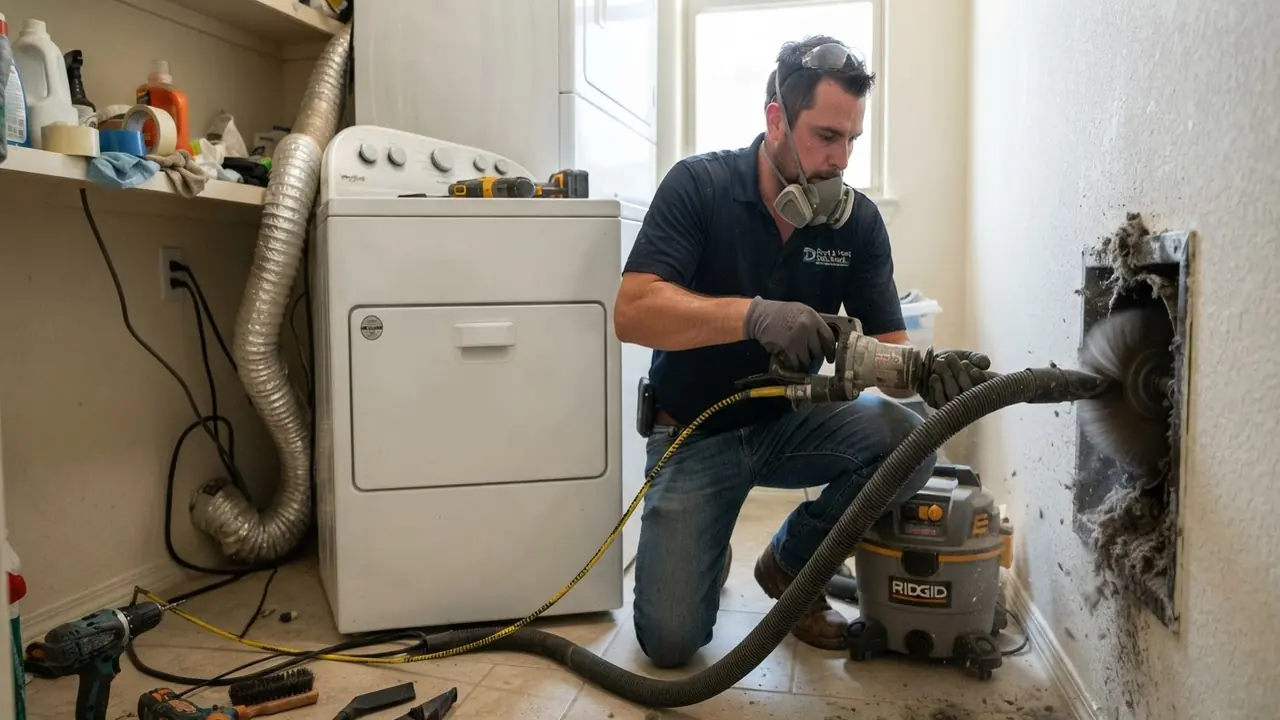
Run rotary brush agitation tools and high-powered HEPA vacuum extraction along the entire run
Clean the dryer chassis blower housing, lint screen cavity, and motor compartment
Clear and test the exterior roof jack or wall damper flap for proper seal and release
Perform post-service static pressure test to verify full airflow restoration
Typical for single-story homes where ductwork runs a short, straight distance out an exterior side wall.
Reflects the extra labor and ladder work required for Circle C two-story homes where vents exhaust onto steep rooflines.
Replacing crushed, outdated foil or plastic transitions with code-compliant semi-rigid metal ducting.
Addresses disconnected attic joints, excessive elbows, or damaged venting materials within unconditioned attic space.
Typical market ranges for the Greater Austin area — not a quote or guarantee. Your actual price depends on scope; compare free quotes from local pros.
Circle C Ranch properties sit on thin topsoil over Edwards limestone, with many homes constructed on slab foundations that require dryer ductwork to navigate expansive, unconditioned attic spaces.
In southwest Austin's humid subtropical summers, attic temperatures routinely exceed 130°F, causing moist lint inside horizontal runs to bake into dense, highly flammable obstructions. Furthermore, severe spring hailstorms and Hill Country winds frequently batter roof exhaust dampers, trapping lint and humid air inside wall cavities.
ContractorPro.Leads is a matching service and doesn't do the work itself. We pass your Circle C Ranch request to a few local companies that take this kind of job, and you decide whether to hire any of them.
Stretching across the 78739 ZIP code near Circle C Metropolitan Park and the Lady Bird Johnson Wildflower Center, this neighborhood features two-story limestone and brick residences built primarily between the 1990s and 2010s. Whether you live near the Veloway or along Escarpment Boulevard, these spacious multi-level layouts often feature longer vent runs with multiple 90-degree elbows. Independent local contractors understand these specific floor plans and carry the specialized equipment needed to clean out dryer vents effectively without damaging roof tiles or duct linings.
Protect your Circle C Ranch home from attic fire risks and cut your energy costs—connect with local dryer vent cleaning contractors for a fast, free quote today!
Most homeowners in Circle C Ranch can expect typical service costs between $140 and $275. Pricing primarily depends on duct length, the number of turns, and whether the exhaust point terminates on a first-floor exterior wall or a high, pitched roofline.
Routine cleaning and basic transition hose replacements do not require permits. However, if your project involves rerouting duct pathways through walls or creating new penetrations through the exterior envelope, work must meet residential mechanical codes overseen by the City of Austin Development Services Dept. (DSD).
When humid Central Texas air combines with attic temperatures exceeding 130°F, lint inside extended duct runs bakes into thick clogs. This backpressure trips high-limit thermal fuses, shutting off heat mid-cycle to prevent motor overheating and leaving clothes damp.
For typical Circle C homes, professional cleaning once a year is standard. If you have an active family running several loads daily, a long vertical attic run, or shedding pets, cleanouts every 6 to 9 months help maintain peak efficiency and prevent fire risks.
Austin Water and Austin Energy do not provide direct rebates for vent cleaning services. However, clearing built-up lint reduces electricity demand significantly, helping you avoid higher tiered electric rates during peak summer cooling months.
