
Perched on the rolling limestone bluffs above Barton Creek, Barton Hills homes often feature multi-level designs and custom renovations where clothes dryer vent lines must traverse extended, indirect pathways. When lengthy ductwork combines with Austin's triple-digit summer heat, trapped lint creates dangerous fire risks and spikes your cooling and electric bills. We connect homeowners across 78704 with dependable independent local specialists equipped to service even the most challenging hillside laundry configurations.
Test initial exhaust velocity and backpressure at the exterior wall or roof cap
Inspect the transition duct behind the dryer for kinks, crushing, or non-code vinyl material
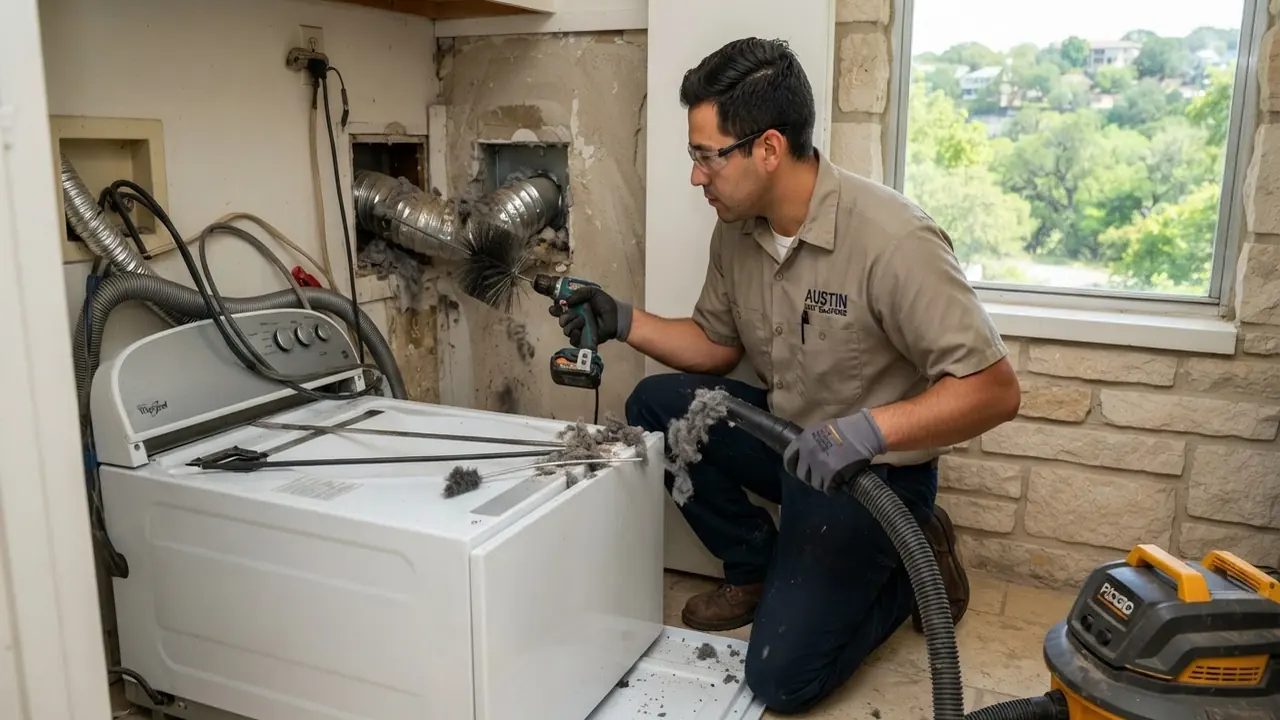
Run commercial rotary brush tools powered through the complete length of the ductwork
Extract loosened lint and debris using a sealed HEPA-filtered vacuum collector
Scrub, clear, and verify proper mechanical operation of the exterior damper or roof jack
Perform a final airflow volume check and appliance sensor test to confirm unrestricted exhaust
Typical for original Barton Hills ranches with direct, ground-floor horizontal vent runs under 15 feet.
Common in split-level homes along Barton Creek where technicians must navigate sloped limestone grades and two-story roof caps.
Addresses disconnected lines, replacing unsafe flexible plastic ducting, or reconfiguring lines to satisfy Austin DSD building safety codes.
Typical market ranges for the Greater Austin area — not a quote or guarantee. Your actual price depends on scope; compare free quotes from local pros.
The steep, terraced terrain above the Barton Creek Greenbelt means many Barton Hills split-levels and remodeled mid-century homes route dryer exhaust upward through high second-story rooflines or down through tight crawl spaces over Edwards limestone bedrock.
During hot, humid 100°F summers, cold air-conditioned interior walls collide with moist, hot laundry exhaust inside these prolonged pipe runs, triggering condensation that turns loose lint into a sticky, plaster-like paste along duct walls. Furthermore, fine limestone and cedar pollen carried on canyon breezes frequently jam exterior flappers, preventing exhaust flaps from opening fully and accelerating dangerous lint blockages inside the home.
ContractorPro.Leads is a matching service and doesn't do the work itself. We pass your Barton Hills request to a few local companies that take this kind of job, and you decide whether to hire any of them.
Bordered by Zilker Park and Barton Springs to the north and the rugged Barton Creek Greenbelt to the west, Barton Hills is renowned for its architectural mix of original 1960s ranch homes, contemporary multistory rebuilds, and native live oak canopies. Whether your property sits along Barton Hills Drive or is nestled quietly on a cul-de-sac overlooking the canyon trails, local residential layouts require an understanding of non-standard venting configurations that flatland contractors often overlook.
Connect with Barton Hills dryer vent cleaning specialists today and get free, no-obligation quotes for your 78704 home.
Pricing in 78704 mainly depends on duct accessibility and total line length. Remodeled homes with laundry relocated to interior closets or master suites often require rooftop access or navigating tight crawl spaces above limestone foundations, requiring specialized safety gear and extended cleaning lines.
Routine clean out dryer vent services do not require a permit. However, if your contractor needs to reroute ductwork through structural framing, cut new exterior exhaust penetrations, or alter mechanical ventilation systems, the work must comply with City of Austin Development Services Dept. (DSD) mechanical codes, which may require a trade permit.
Most Barton Hills households should schedule clothes dryer vent cleaning once a year. If you have an active family running multiple loads daily, or an interior laundry room with an extended duct run over 25 feet, semi-annual inspections are strongly advised to keep lint accumulation in check.
Yes. Austin's humid subtropical climate causes hot, wet exhaust air to hit cool AC-conditioned wall spaces, generating interior pipe condensation. This causes lint to turn into a dense sludge that clings to duct walls, creating early blockages and overworking your dryer motor during summer heatwaves.
While Austin Water and Austin Energy do not offer standalone rebates solely for cleaning vents, keeping your duct clear directly supports whole-home energy efficiency targets and pairs well with Austin Energy rebates for upgrading to qualifying heat pump dryers and air sealing improvements.
