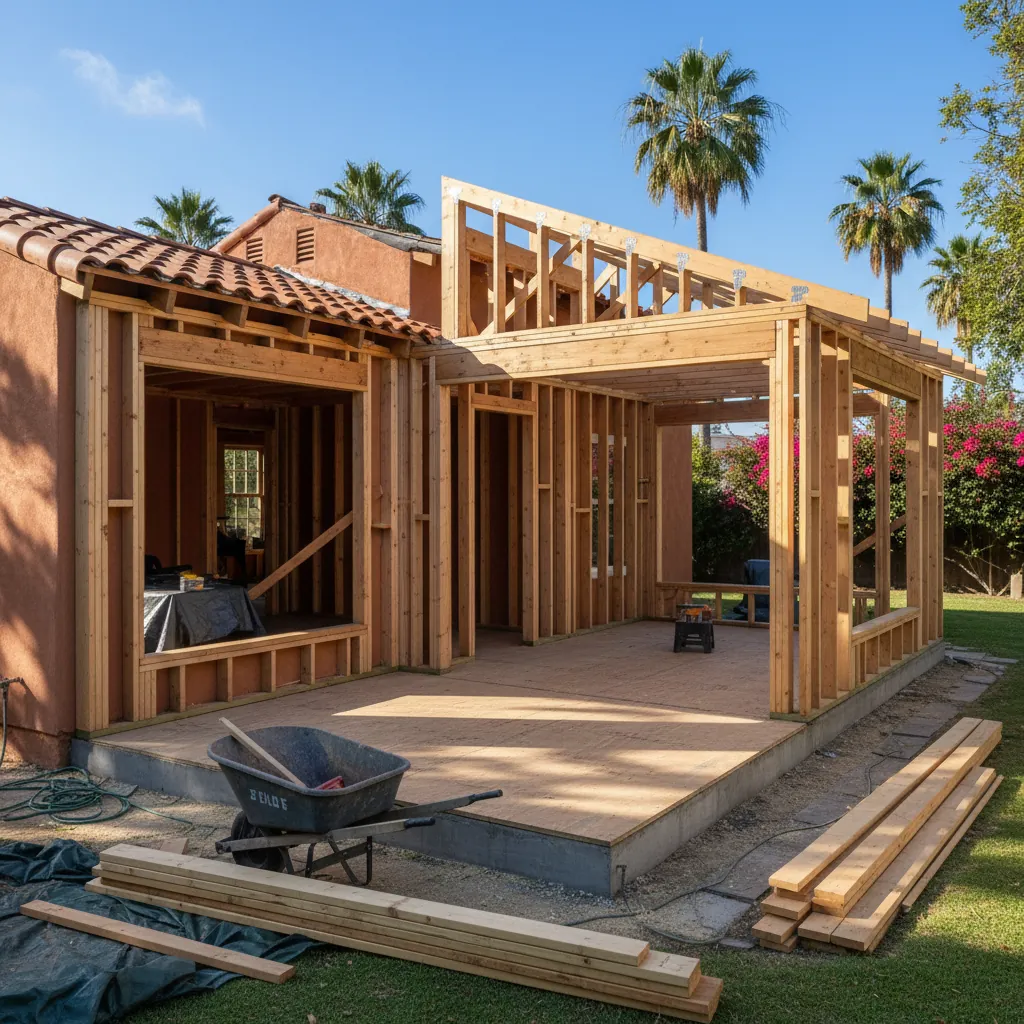
Expanding your home in Granada Hills offers the perfect way to add square footage without leaving this beautiful corner of the San Fernando Valley. Whether you want to build out a spacious master suite or add a second-story addition to capture mountain views, local contractors can turn your vision into reality. We connect you with experienced builders who understand the unique architectural character and zoning of ZIP code 91344.
Get free quotesBuilding a room addition in Granada Hills requires navigating distinct geographical and environmental conditions. On the flatter parts of the Valley floor, expansive clay soils require specialized foundation engineering to prevent shifting. As you move north into the foothills near Knollwood, builders must account for sloped lots, rocky terrain, and strict Wildland-Urban Interface (WUI) fire-safety building codes, which mandate ignition-resistant materials like dual-pane tempered glass and boxed eaves to protect against seasonal brush fire risks.
From the mid-century modern homes lining the streets near Balboa Boulevard to the larger properties bordering O'Melveny Park and the Knollwood Country Club, Granada Hills boasts a diverse architectural landscape. Local contractors are highly experienced in matching the aesthetic of existing structures while optimizing your lot's footprint. They ensure your home expansion respects both local neighborhood character and the natural slope of the northern foothill terrain.
Ready to expand your Granada Hills home? Contact us today to match with top-rated local room addition contractors and request a free project estimate.
Get free quotesPermits are processed through the City of Los Angeles Department of Building and Safety (LADBS). While simple structural additions might go through expedited review, typical room additions in Granada Hills—especially those on sloped lots or within fire-hazard zones—require a comprehensive plan check that generally takes 8 to 16 weeks to secure approval.
In Granada Hills, site preparation is a major cost variable. Properties on the flat Valley floor deal with expansive clay soils requiring robust concrete foundations, while hillside properties near the foothills require grading, retaining walls, and specialized engineering. Additionally, homes in the fire-prone WUI zones must use fire-rated siding, roofing, and vents, which can impact material costs.
Yes. If your room addition requires updating your landscaping or adding new plumbing fixtures, you can take advantage of LADWP rebates. These include significant incentives for turf replacement to install drought-tolerant landscaping, as well as rebates for high-efficiency toilets, smart irrigation controllers, and energy-efficient heat pump systems.