Set along the rolling terrain leading down to Lake Austin, Tarrytown homes face unique indoor air challenges from seasonal Hill Country allergens and persistent lakeside moisture. Whether you live in a preserved mid-century cottage or an expansive modern build, keeping your ventilation paths clear ensures healthy air and efficient cooling.

Initial diagnostic camera inspection of registers, trunk lines, and return plenums
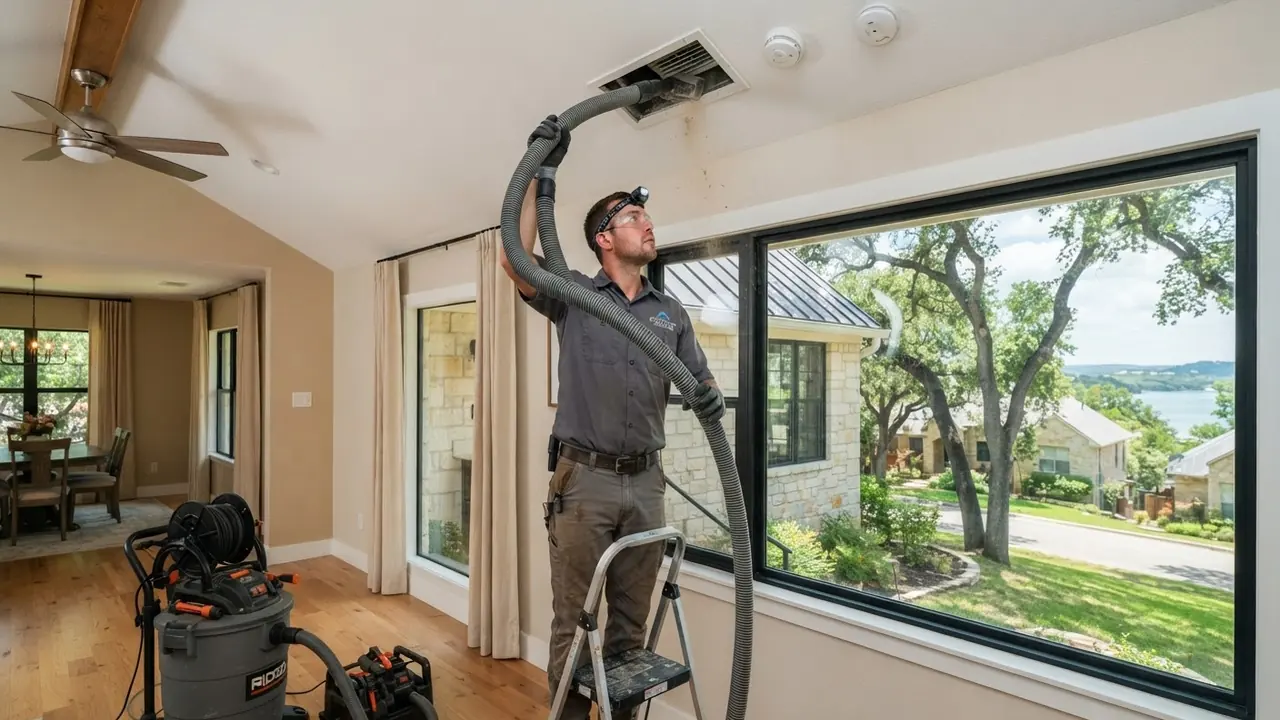
Negative-air vacuum containment connected to seal debris away from living spaces
Agitation with high-pressure air whips and rotary brushes throughout supply and return lines
Detailed cleaning of register grilles, blower wheels, and evaporator coil faces
Complete clothes dryer vent cleaning from appliance coupling to the exterior terminal
System pressure re-test and final inspection walk-through with the homeowner
Typical for classic Tarrytown 1-story homes with up to 12-15 registers and single attic-mounted air handlers.
Applies to larger two-story residences or expanded properties requiring dual negative-air vacuums and multiple plenum cleanings.
Ground-floor exterior terminations; often discounted when performed alongside whole-house air duct cleaning.
Common in updated Tarrytown homes with second-floor laundry rooms vented across attics to steep roofs.
Sealing minor leaks and joint separations discovered during cleaning to prevent pulling hot attic air into the system.
Typical market ranges for the Greater Austin area — not a quote or guarantee. Your actual price depends on scope; compare free quotes from local pros.
Tarrytown's position on the Hill Country edge—where expansive clay rests over limestone shelves sloping down to Lake Austin—creates a distinct climate pocket.
High relative humidity from the lake mixes with 100°F summer heat, causing unconditioned attics and crawlspaces to develop duct condensation that attracts fine limestone dust and encourages microbial growth. Without routine cleanouts, older flex ducts and rigid metal plenums common to 78703 cycle trapped humidity and musty spores directly into living areas during relentless summer cooling cycles.
ContractorPro.Leads is a matching service and doesn't do the work itself. We pass your Tarrytown request to a few local companies that take this kind of job, and you decide whether to hire any of them.
From the leafy avenues surrounding Lions Municipal Golf Course to quiet residential enclaves near Mayfield Park and the Lake Austin waterfront, Tarrytown features a blend of original 1940s architecture and modern renovations. The heavy canopy of heritage live oaks and pecans produces heavy spring pollen, which quickly migrates into attic duct networks. Connecting with local pros who understand Tarrytown's diverse building eras ensures your duct system is cleaned effectively without damaging delicate aged duct linings or historical trim.
Connect with documented air duct and dryer vent cleaning professionals in Tarrytown today to get fast, upfront estimates.
Most duct cleaning projects in Tarrytown fall between $350 and $650 for a standard single-system home. Costs are driven by home square footage, number of vents, accessibility of the attic or crawlspace, and whether you bundle clothes dryer vent cleaning. Larger renovated estates with multiple air handlers typically range from $700 to $1,300. Many independent contractors we connect you with also offer flexible financing options for extensive duct rehabilitation.
Yes. Independent pros in our local network frequently accommodate same-day or next-day appointments in Tarrytown, particularly for emergency dryer vent clogs that pose an active fire risk or after sudden HVAC contamination from roof leaks, mold discovery, or pest breaches.
Tarrytown sits near Lake Austin, where ambient humidity routinely clashes with chilled AC ducts. If unconditioned attic ducts lack sufficient insulation, condensation forms along the plenum walls, generating a sour or musty smell. Additionally, foundation shifts on local clay-over-limestone soils can loosen duct joints, drawing fine attic dust, insulation fibers, and cedar pollen directly into your air supply.
If your ductwork has degraded fiberglass insulation shedding particles, crushed flexible ducting, or extensive mold rot, cleaning alone is insufficient. Minor joint separation can be taped and sealed with mastic, but extensively damaged systems require replacement. The independent contractors we connect you with can evaluate repair-vs-replace scenarios and pull required mechanical permits with the City of Austin Development Services Dept. (DSD) if full replacement is necessary.
While routine cleaning is classified as standard home maintenance, Austin Energy offers customer rebates for comprehensive duct sealing and HVAC efficiency upgrades.
